Trezor is one of the most respected names in cryptocurrency security, pioneering the concept of the hardware wallet when it launched the world's first consumer-grade cold storage device — the Trezor Model One — back in 2014. Over a decade later, Trezor's product lineup has expanded to include the Trezor Model T, Trezor Safe 3, and the flagship Trezor Safe 5, all built on the same principle: your private keys never leave the device, and only you control your crypto.
But that same principle also means that if you lose access to your Trezor device or its backup credentials, no central server, no Trezor support team, and no third party can restore your wallet on your behalf. Recovery is entirely in your hands.
The encouraging truth is that Trezor wallet recovery is fully achievable across nearly every scenario — provided the right method is applied to the right situation. This comprehensive guide covers every recovery type Trezor users may encounter, across all current and legacy device models.
Trezor's lineup has evolved significantly since 2014. All models in the current and legacy range use the BIP39 recovery seed standard, meaning recovery seeds are interoperable across all Trezor devices.
All Trezor models generate recovery seeds in Shamir Backup (SLIP39) or standard BIP39 mnemonic format, depending on user preference during setup. This guide covers both formats.
The Trezor recovery seed — a 12, 20, or 24-word mnemonic — is the master backup of everything stored in your Trezor wallet. It is the sole mechanism through which full wallet access can be restored on any device at any time.
Important: For the Model One, words are entered using a scrambled on-device keyboard displayed through Trezor Suite's interface, which never reveals the actual seed to the computer at any point.
Discovering that one word is missing from your Trezor recovery seed is one of the most stressful situations a crypto holder can face — but it is not necessarily fatal to recovery.
Standard BIP39 seeds use a fixed wordlist of 2,048 words. If only one word is missing from a 12 or 24-word phrase, the total number of combinations to test is exactly 2,048 — a finite and solvable problem with the right tool.
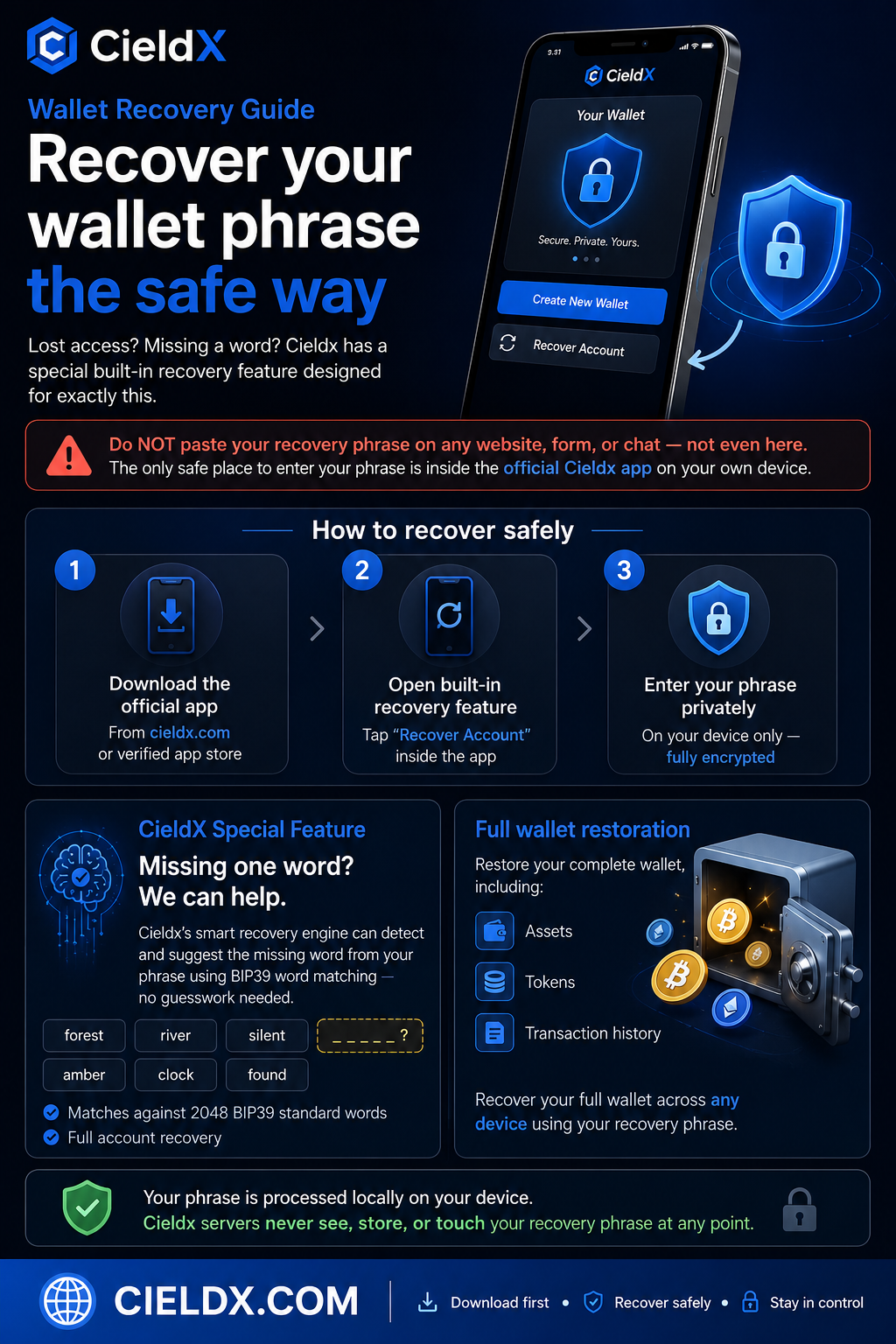
Manual iteration of 2,048 combinations is error-prone and time-intensive. Specialized recovery platforms like Cieldx are purpose-built for this exact scenario — automating the BIP39 word-matching process and identifying the missing word without requiring deep technical knowledge from the user.
For Shamir Backup (SLIP39) users on Trezor Safe 3 or Safe 5: recovery requires a minimum threshold of shares (e.g., 2 of 3 shares), not a single seed phrase. A missing word within one share follows a similar iterative process.
Wallet restoration means fully rebuilding your Trezor wallet after a device is wiped, replaced, or reset. This is the standard recovery path for users who:
The restoration process is straightforward: connect the new device, open Trezor Suite, select "Recover wallet", and enter your seed directly on the device screen. All accounts, addresses, and on-chain assets are fully restored.
Trezor uses a device PIN — not a server-stored password — meaning Trezor cannot remotely reset it. If you forget your PIN:
There is no bypass for a forgotten PIN without the recovery seed. This is a deliberate security design — if someone steals your Trezor but does not have your seed, the wipe-on-failure mechanism protects your funds.
Trezor uses hierarchical deterministic (HD) wallet architecture, generating multiple accounts across multiple blockchains from a single recovery seed. After restoration, some accounts may not immediately appear in Trezor Suite.
All on-chain assets remain intact — they simply need to be re-derived and made visible within the Suite interface.
If your physical backup of the Trezor recovery seed is damaged, partially illegible, or deteriorated, the recovery path depends on how much remains readable:
For Shamir Backup users with multiple shares: if one share is partially damaged but others are complete and the threshold is met, recovery may still be possible without the damaged share — a key advantage of the Shamir system over single-seed backups.
This is why Trezor now recommends Shamir Backup as the default for Safe 3 and Safe 5 users — it provides redundancy that standard BIP39 single-seed backups do not offer.
A completely lost wallet scenario — no recovery seed, no device access — represents the most difficult recovery situation.
This is why Trezor's setup wizard enforces a mandatory seed backup verification step. Skipping it or not backing it up correctly is the single leading cause of permanently lost funds.
Trezor Suite can occasionally experience software-side issues — corrupted local data, failed sync, or accounts showing incorrect balances. Since all asset data lives on-chain, not inside Trezor Suite:
Trezor's entire product range is seed-compatible, making device migration seamless:
Your Trezor BIP39 seed is compatible with MetaMask, Trust Wallet, Phantom, and most other non-custodial wallets. Simply import using the standard seed import option in the destination wallet's app.
Power users often manage multiple Trezor devices with separate recovery seeds — one for daily use and another for long-term cold storage. Recovering multiple wallets requires:
For complex setups — particularly those involving Shamir Backup shares across multiple physical locations, or multiple devices across different Trezor models — Cieldx provides structured multi-wallet recovery assistance, helping users methodically restore and verify each wallet across Bitcoin, Ethereum, and all supported networks.
Trezor supports an optional BIP39 passphrase (called the "hidden wallet" feature in Trezor Suite) that adds an extra word — chosen by the user — on top of the standard recovery seed. This creates an entirely separate wallet that is invisible without the exact passphrase.
If this passphrase is forgotten:
Trezor's hidden wallet passphrase must be treated with the same care as the seed itself — stored separately in a secure, offline location.
Beyond standard seed recovery, Trezor supports several additional import and restoration paths:
For complex recovery scenarios — especially missing mnemonic words, multi-device recovery, or forgotten passphrase situations — Cieldx provides specialized recovery assistance tailored to Trezor's architecture.
Cieldx is a dedicated digital asset recovery portal with a specialized built-in engine for Trezor and 100+ blockchain wallets. If you are missing one word from your Trezor 12, 20, or 24-word recovery seed, Cieldx's intelligent BIP39 word-matching engine automatically scans all 2,048 standard candidates to identify the missing mnemonic — restoring full wallet access without manual guesswork or deep technical knowledge. Beyond missing word recovery, Cieldx supports multi-device recovery, Shamir Backup assistance, device migration between Trezor models, and corrupted Suite data recovery across Bitcoin, Ethereum, Cardano, Solana, and all major Trezor-supported networks. Every recovery session runs in a fully encrypted, client-side environment — your seed never leaves your device or touches external servers at any point during the process. Always download the official Cieldx app first, then use its secure built-in recovery feature on your own device. Visit cieldx.com to begin your safe, guided Trezor recovery today.
| Recovery Type | What You Need | Difficulty | Applicable Models |
|---|---|---|---|
| Seed Phrase Recovery | 12/20/24-word seed | Easy | All models |
| Missing Word (11/12 or 23/24) | Partial seed + BIP39 tool | Medium | All BIP39 models |
| PIN/Password Recovery | Recovery seed | Easy | All models |
| Account Access Recovery | Recovery seed | Easy | All models |
| Lost Wallet | Seed phrase or device | Hard | All models |
| Corrupted Suite Data | Reinstall Suite | Easy | All models |
| Device Migration | Recovery seed | Easy | All models |
| Multi-Wallet Recovery | All individual seeds | Medium | All models |
| Forgotten BIP39 Passphrase | Exact passphrase | Very Hard | Model T, Safe 3, Safe 5 |
| Shamir Backup Recovery | Threshold of shares | Medium | Safe 3, Safe 5 |
| Legacy Account Recovery | Recovery seed | Medium | Model One, Model T |
Trezor's security model — across the Model One, Model T, Safe 3, and Safe 5 — is built on a simple but uncompromising principle: your keys, your crypto, your responsibility. The hardware-enforced seed entry process, the PIN wipe-on-failure mechanism, and the optional Shamir Backup system all exist to protect you — but they also mean that recovery without proper credentials is not possible through any official channel.
The five non-negotiable rules for every Trezor user:
Your Trezor wallet remains fully recoverable for as long as your seed backup remains intact and secure.